


Some cities reveal their history through monuments. Granada reveals it through the relationship between its landscape, architecture, water and the people who have shaped it.
Granada is often introduced through a familiar image: the Alhambra rising above the city, the narrow streets of the Albaicín, the Sierra Nevada in the distance. It’s an image of extraordinary beauty, and one that has become to define how many people imagine the city.
Yet Granada is more than the sum of its celebrated monuments. Successive political, cultural and social transformations shaped its identity. These are visible not only in its palace and churches, but also in its urban structure, its water system, its neighbourhood and the relationship between the city and the fertile landscape surrounding it.
To understand Granada, look beyond the monuments and read the layers that have made it what it is today.
A city shaped by water

Before looking at Granada’s architecture, worth considering something less immediately visible: water.
The medieval city’s development depended on the ability to bring water from the surrounding landscape into its settlements, gardens and agricultural areas. This required considerable technical knowledge and the construction of an extensive network of channels, reservoirs and distribution systems.
Some of these infrastructures had earlier origins, but they expanded significantly under the Zirid dynasty in the eleventh century and reached an important level of development during the Nasrid period, which lasted from the thirteenth to the fifteenth century.
One particularly important example was the Acequia de Aynadamar, which carried water from Alfacar’s area towards the Albaicín. Other channels supplied the Alhambra and its gardens, allowing a complete palatial and residential environment to develop on the Sabika hill.
Water was not simply a decorative feature of Islamic architecture. It was essential to the city’s functioning. It supported agriculture, domestic needs and made possible the garden and cultivated spaces that became such an important part of Granada’s urban landscape. Its distribution also required rules, maintenance and management.
This infrastructure’s importance did not disappear with the end of Nasrid rule. Water continued to shape daily life for centuries, and sixteenth-century historical records show how carefully they regulated its distribution.
Looking at Granada through its water systems offers a different perspective on its history. It reveals a city shaped by the practical knowledge required to live in a particular landscape.
When one city became another
On 2 January 1492, Granada surrendered to the Catholic Monarchs, Ferdinand of Aragon and Isabella of Castile. The event marked the end of the Nasrid Kingdom of Granada and the final stage of the Christian conquest of the Iberian Peninsula.
But the city’s transformation was not immediate. The Capitulations of Granada initially established conditions intended to protect the religious and cultural practices of the Muslim population under the new Christian government. For several years, Granada remained predominantly Muslim in its population, and many aspects of its urban and social life continued.
However, those guarantees progressively gave way to policies of religious conversion and cultural assimilation.
The turning point came in 1499, when Archbishop Francisco Jiménez de Cisneros pursued a more coercive policy towards the Muslim population. Unrest broke out in the Albaicín and subsequently spread to other parts of the former kingdom.
Forced conversions followed, and muslims who had been compelled to convert to Christianity became known as Moriscos. Their religious and cultural practices nevertheless remained subject to increasing restrictions.
During the reign of Philip II, legislation introduced in 1566 further restricted aspects of Morisco culture, including language, dress and customs. These measures contributed to the rebellion that began in 1568 in the Alpujarras.
The uprising was eventually defeated, and the Morisco population of the Kingdom of Granada was forcibly dispersed in the early 1570s.
This history is essential to understanding the city. The transition from Nasrid Granada to Christian Granada was not simply a change in architectural styles or political authority. It involved communities’ displacements, religious institutions’ transformation and suppression of cultural practices.
The city that emerged from this process retained much of its earlier physical structure, but its social and cultural composition had changed profoundly.
Granada’s history is therefore not a simple story of successive cultures peacefully adding their contributions. It is a history of conquest, negotiation, adaptation, resistance and loss.
The neighbourhoods that remember

Granada’s layered history is more visible in its historic neighbourhoods.
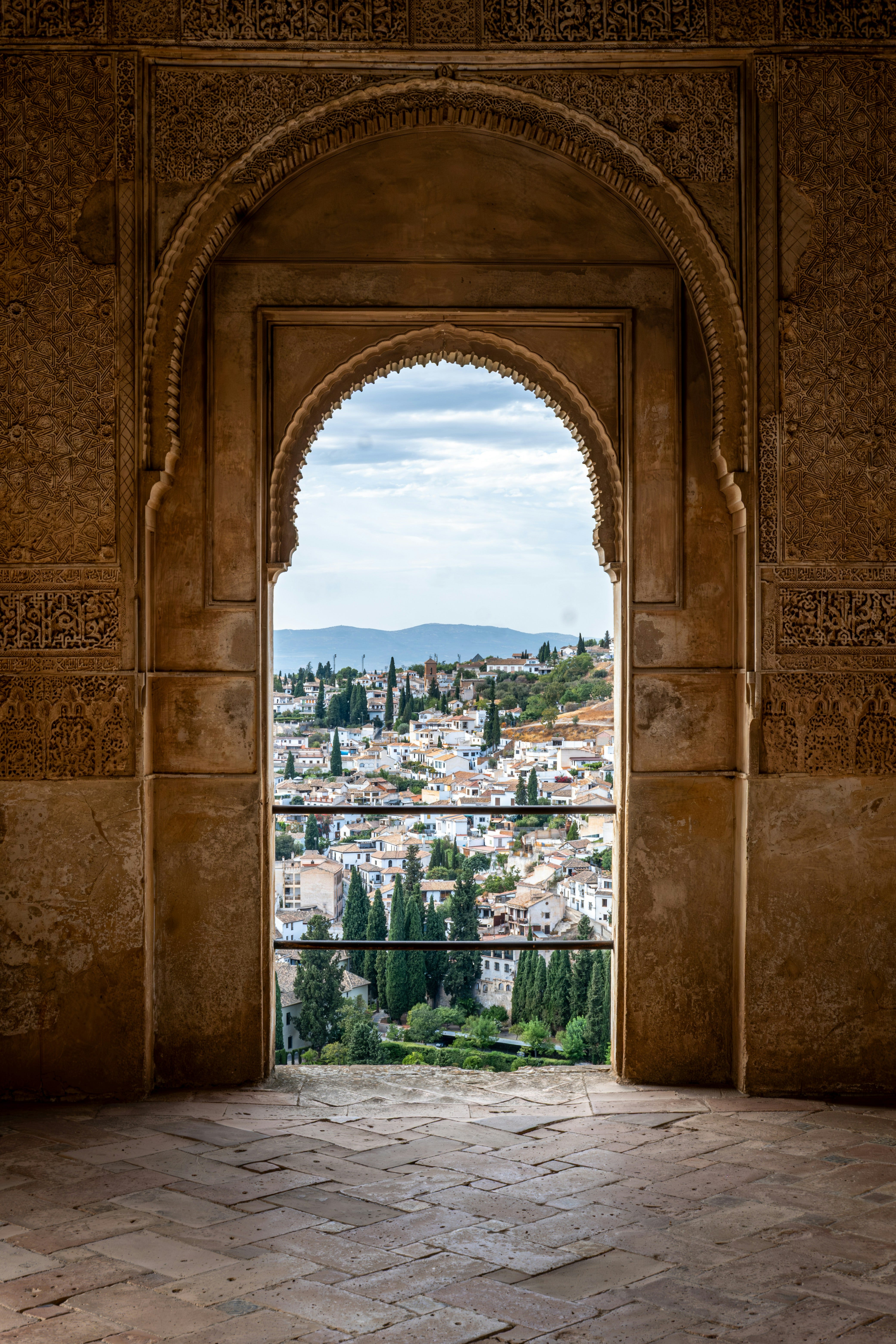
The Albaicín, facing the Alhambra across the Darro valley, preserves much of the urban structure associated with the medieval city. Its narrow streets, small squares, traditional houses and irregular layout reflect how urban space was organised over centuries.
Yet the neighbourhood is not a preserved fragment of a single historical moment. Its architecture incorporates different periods and influences. Nasrid structures coexist with buildings and interventions from the Christian Renaissance and Baroque periods. Churches occupy sites connected to the earlier Islamic city, while traditional domestic architecture continues to shape the character of its streets.
This coexistence is particularly interesting because it shows how urban spaces can retain earlier forms while acquiring new meanings and functions.
The Albaicín is not simply a reminder of Granada’s Islamic past. It is also evidence of the transformations that followed.
Further east, the Sacromonte offers another perspective of the city’s history. Its cave dwellings are among the neighbourhood’s most recognisable features. These homes, adapted to the area’s hillside terrain, became associated with communities whose histories are an important part of Granada’s cultural identity.
The development of the Sacromonte as a neighbourhood is connected to the social transformations of the sixteenth century. Its history includes the settlement of different groups, among them, Roma communities, whose presence became especially important to the area’s cultural life.
Over time, the Sacromonte also acquired a powerful cultural image through flamenco, the xambra and the representation of Roma traditions.
But there is a distinction worth making between a community’s history and the image of that community created for visitors. Research into tourism and cultural representation in the Sacromonte shows how the neighbourhood’s image has been shaped, particularly from the nineteenth century onwards, by romantic and exotic interpretations. These representations became part of Granada’s international tourist imagination.
Understanding the Sacromonte therefore requires looking beyond its picturesque appearance and considering the people, identities and social changes that have shaped it.
A neighbourhood is never just an architectural or natural setting. Communities live there, and adapt and negotiate their relationship with the past.
Beyond the monumental city

Granada’s historical importance is often associated with the Alhambra, but the palatial complex itself was part of a much larger urban and agricultural system.
The Alhambra was not an isolated palace. It functioned as a fortified palatine city, with residential, administrative, military and productive areas. Its relationship with the surrounding landscape was essential to its development.
The Generalife, traditionally associated with the Nasrid ruler's rural residence, illustrates this connection between architecture, gardens and agricultural land.
The irrigation systems that supplied these spaces also connected the palatial city with the wider territory. They reveal how political power, agricultural production and landscape management were closely related.
This broader perspective changes how we understand Granada’s monuments. Rather than seeing the Alhambra as a beautiful architectural object separated from the rest of the city, we can recognise it as part of a complex system of relationships among settlement, water, agriculture and power.
It also reminds us that Granada’s history cannot be confined to the places that attract the greatest number of visitors. Its streets, traditional houses, water channels, public spaces and surrounding agricultural landscape all contribute to the story.
A city still being written

Granada’s history did not end with the disappearance of the Nasrid kingdom or the transformation of its religious and political institutions. The city continued to change.
Its historic buildings acquired new uses, neighbourhoods evolved, and new architectural styles were introduced. Over time, the relationship between the monumental centre and the wider city also changed.
Today, Granada faces the same challenge as many historic cities: how to preserve its cultural heritage while remaining a living place for its inhabitants.
The Alhambra and the Albaicín have international recognition as World Heritage Sites, but Granada’s cultural identity value extends beyond these protected monuments. It also lies in the knowledge associated with its traditional architecture, its historical irrigation systems, its neighbourhoods and the practices that have continued or adapted through generations.
Preserving a city does not simply mean protecting old buildings. It also means understanding the relationships that give those buildings meaning.
This is especially important in places where cultural heritage has become a central part of the visitor’s experience. The challenge, more than avoiding them, is allowing its historical character to remain connected to contemporary life.
Learning to read Granada
To read Granada is to look beyond its most familiar image.
It is to recognise the water systems that made its development possible, the urban structures that preserve traces of its medieval past, and the profound social changes that followed the conquest of 1492. It is also understood that the city’s identity cannot be reduced to a single period, culture or architectural style. Granada is a city of continuities and ruptures. Its past remains visible in the landscape, in the spaces that were transformed, the traditions that evolved and the communities whose histories are part of its identity.
Granada invites us to look closer, question familiar images and discover how history continues to shape the places we inhabit.
A city is never what we see; it is everything that happened before us, and everything that continues to happen around us.