

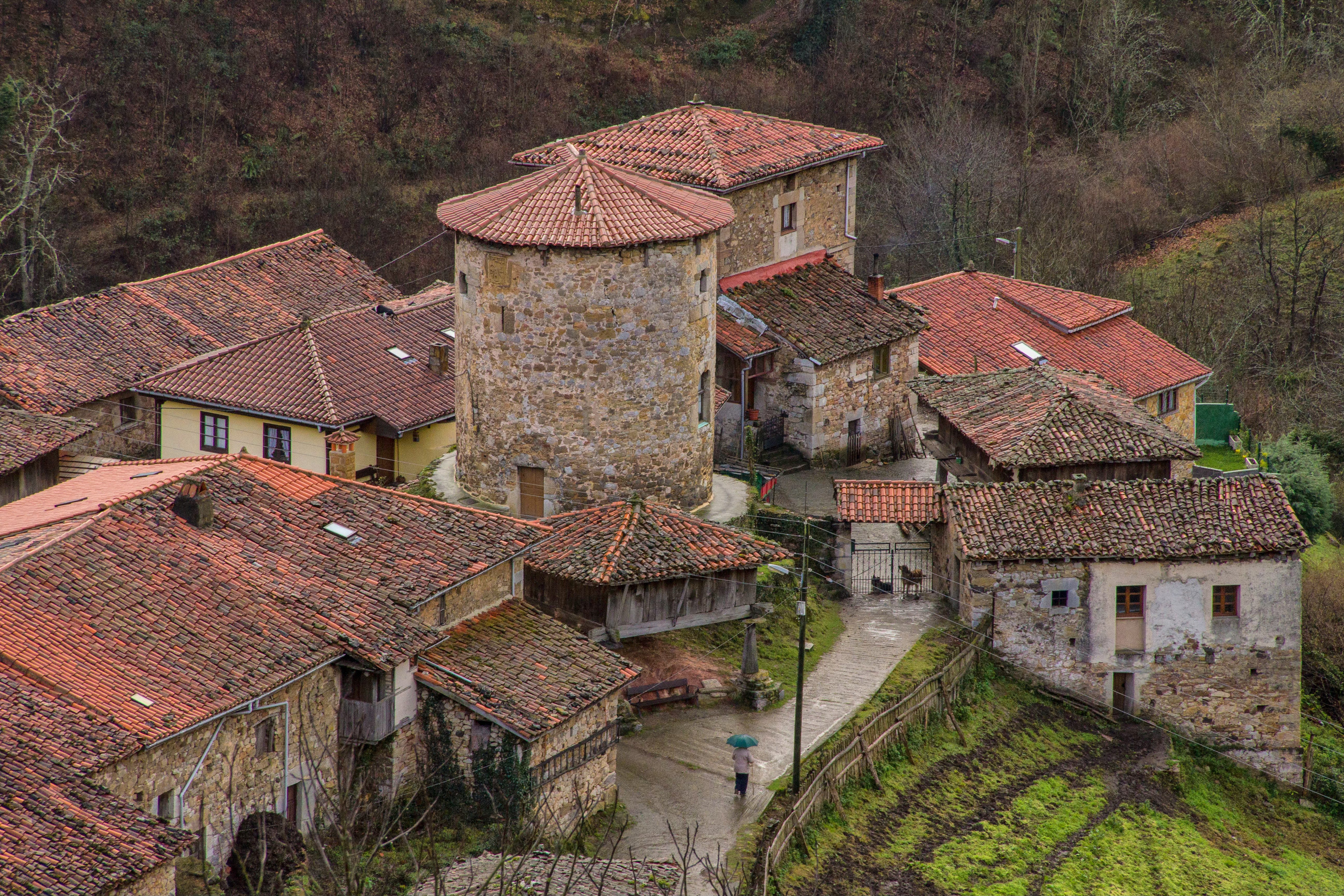
A landscape can be beautiful without being fully understood. Asturias, in northern Spain, is often introduced through its mountains, green valleys, rugged coastline, and rural villages. These are essential parts of its character, but they reveal only one dimension of the region. Look a little closer, and another landscape emerges: one shaped by generations of agricultural work, apple cultivation, the rhythms of mining communities and the gradual transformation of the industries that once sustained them.
Here, the territory is more than a natural setting. It holds traces of how people learned to live from the land, organised their communities and adapted when familiar ways of life began to change.
Reading Asturias is about looking beyond what the landscape shows at first glance and asking what made it this way.
The knowledge held in everyday things
In rural Asturias, some of the most revealing structures are not grand buildings or formal monuments. They are the ordinary elements that once made everyday life possible.
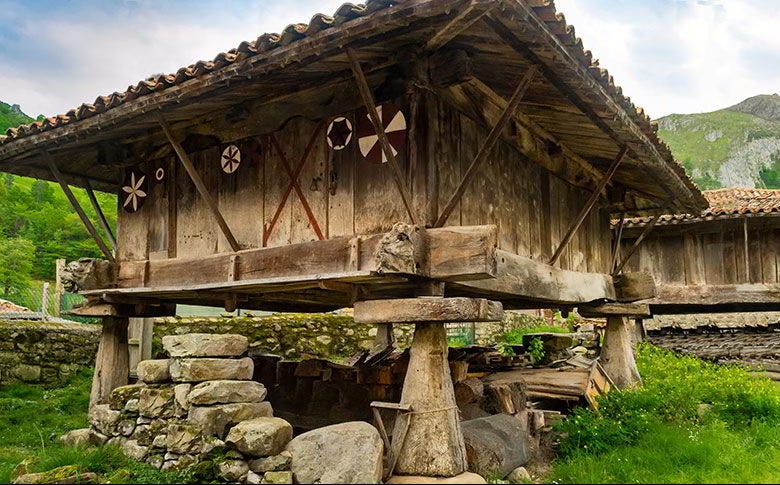
The hórreo, a traditional raised granary, is one example. Its elevated wooden structure helped protect harvested crops from rodents and moisture, making it an important part of the rural economy. Its form reflects a practical response to the demands of storing food and managing agricultural resources.
The building is therefore more than a familiar feature of the Asturian landscape. It shows a relationship between architecture, climate and the work of sustaining a household.
The same principle applies to other elements of the rural environment: orchards, paths, mills and agricultural buildings. Each can be approached as a trace of decisions made over time: where to cultivate, how to preserve a harvest, how to use available resources and how to organise daily work.
These details invite a different way of looking at a place. Instead of treating the countryside as an untouched panorama, we can begin to recognise it as a landscape shaped by human knowledge and repeated practice.
The distinction matters. A landscape may appear timeless, but the ways people inhabit it result from adaptation, labour and accumulated experience.
When product becomes a culture

Few examples illustrate the relationship between territory and everyday life in Asturias as clearly as cider.
The story begins with apple cultivation, but it does not end with the fruit. Growing apples, selecting varieties, making cider, serving it and sharing it have developed into an interconnected set of practices, skills and social customs.
In 2024, UNESCO inscribed Asturias cider culture on its Representative List of the Intangible Cultural Heritage of Humanity. Its recognition encompasses the spaces and processes involved in producing, serving and enjoying natural cider, acknowledging the relationship between rural communities and their environment.
This wider perspective helps explain why cider cannot be understood simply as a regional drink.
The orchards connect it to the agricultural landscape. The llagar, or cider house, connects it to production and specialised knowledge. The chigre and the sidrería connect it to social life, where people share cider through recognisable customs and rituals. The culture exists in the relationship between these elements.
It is also transmitted through practice: through people who cultivate apple trees, produce cider, maintain local knowledge, and introduce younger generations to established customs. At the same time, these traditions continue to operate within changing economic and social conditions.
A product becomes part of a culture when it lives beyond its production. It gathers habits, places knowledge, and shared meaning around itself.
In Asturias, cider offers a way to read this process in the landscape itself - from the trees that grow there to the spaces where people come together. `
When work reshapes a territory
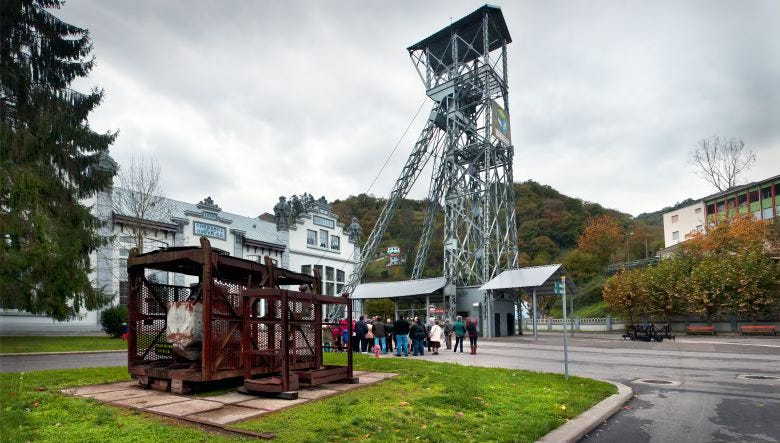
Asturias’s landscape also tells a story of profound industrial transformation.
During the nineteenth and twentieth centuries, coal mining and related industries helped reshape the region’s economy and settlements. New workplaces, transport infrastructure, and residential areas developed alongside older rural landscapes. Valleys long associated with agriculture became connected to a different system of production, employment and everyday life.
The mining settlement of Bustiello, in the municipality of Mieres, offers a particularly revealing example. Built by the Sociedad Hullera Española between 1890 and 1925, the settlement brought together workers’ housing, company engineers, a school, a church and other communal facilities. Its layout was not simply a collection of buildings placed near a mine. It reflected a deliberate attempt to organise the residential and social environment of a mining community.
Bustiello also reveals the unusual relationships embedded in this transformation. The settlement is recognised as an example of industrial paternalism: the company provided facilities and housing while exercising considerable influence over the community’s organisation and everyday life.
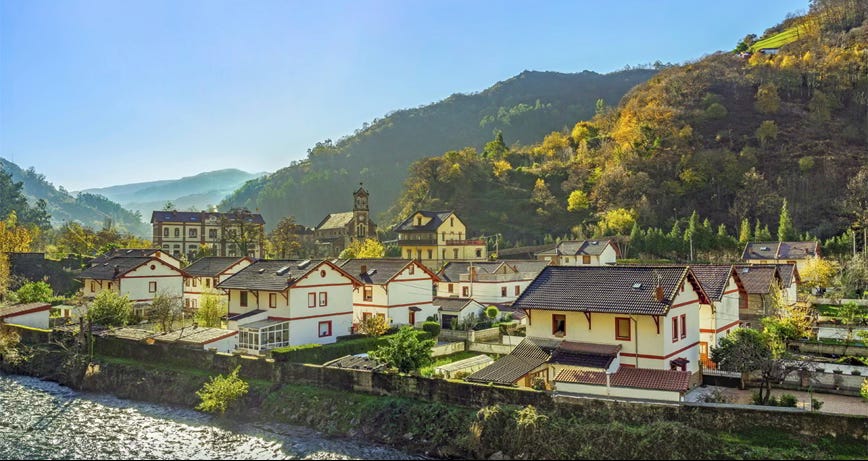
The buildings, therefore, tell more than a story of industrial development. They reveal how economic power could shape the spaces where people lived, learned, gathered and worked.
This is one reason industrial heritage deserves to be read as more than a collection of impressive structures. A mine, a railway, a worker’s settlement or a former industrial building becomes part of a wider network of relationships among labour, infrastructure, institutions and community.
The landscape changed because the way people worked changed. And as work reorganised the territory, it also reshaped the conditions of everyday life.
What remains when a way of life changes?
What happens when the activity that has organised a community for generations begins to disappear?
The decline of coal mining in Asturias raises this question in a particularly tangible way. The end of industrial activity does not erase the structures, memories or social relationships that developed around it. Nor does it produce a single, uniform experience for the communities affected.
Research on the memory of deindustrialisation in Asturias’s mining basins has examined how people narrate this decline, how communities have responded to it and how the legacies of industrial life persist even as the sector has contracted.
These legacies are material, but they are also social and cultural.
A former industrial site may survive as a physical structure. The memory of work may remain in family histories, local identities and accounts of community life. Buildings can acquire new uses, while others may be left abandoned or become the subject of debates about conservation and redevelopment.
The same place can therefore hold several layers of time: the landscape that existed before industrialisation, the structures built to support mining and the traces of what happened after that activity declined.
Preserving this heritage is not simply keeping old buildings standing. It also involves understanding the relationships that gave them significance and the changes that followed.
Preservation does not necessarily mean returning a place to an imagined past. A landscape remains part of the present, even when the activities that once shaped it have changed.
The challenge is to recognise what has been inherited while leaving room for new ways of inhabiting and interpreting it.
Learning to read a landscape
From the hórreo to the apple orchard, from the chigre to the mining settlement, Asturias offers different ways to understand how people and territory shape one another. These elements do not belong to a single, unchanging story. They reflect different forms of work, social relationships and responses to the conditions of their time. What connects them is the possibility of reading the landscape as evidence.
A traditional structure can reveal practical knowledge. A local product can reveal the relationship between cultivation, production and sociability. An industrial settlement can reveal how economic activity shapes not only buildings, but also communities and everyday life. The remains of an industry can raise questions about memory, identity and a place.
Looking at Asturias in this way shifts the focus from what a destination contains to what its places can help us understand.
The landscapes become more than a backdrop for travel. They become a way into history and culture, records of what people have built, maintained, transformed, and left behind.
A landscape is never inherited. The people who live and work within it shape it, and changes alter their relationship with the territory.
To read a place is to recognise those layers, and to understand that what we see today is only one moment in a much longer story.
Imagine Credits
Bandujo, Asturias: https://unsplash.com/es/@guillermoalvarez
Hórreo: https://www.turismoasturias.es/-/blogs/los-horreos-de-asturias-un-sueno-en-el-aire
Cider: https://www.turismoasturias.es/-/blogs/guia-para-disfrutar-de-la-sidra-asturiana
Industrial heritage: https://www.turismoasturias.es/en/-/blogs/asturias-y-su-patrimonio-industrial-corazon-de-metal-y-mineral
Bustiello: https://www.turismoasturias.es/-/blogs/bustiello-una-visita-al-legado-minero-de-asturias